The Cruelty of Economic Policy
By James Quillian, Economist, Political Analyst & Teacher of Natural Law
There’s a special kind of cruelty in modern economic policy, and it isn’t found in the fine print of legislation or the footnotes of a Federal Reserve report. The real cruelty is in the management of public sentiment — the quiet, steady shaping of what folks are allowed to see, hear, and think.
Why manage public sentiment? Why not manage the sentiment of billionaires and the one‑percent crowd? Well now, that’s a good one. You might as well ask a rancher why he doesn’t put blinders on himself instead of the horses.
When horses pull a wagon, you fit them with blinders so they don’t spook at shadows or wander off the trail. “Keep your eyes forward, keep pulling, don’t ask questions.” That’s the message from man to horse. And it works. The same message, dressed up in patriotic colors, works on the public.
 Public sentiment is managed by withholding information and polishing the rest. Every government statistic is buffed to a shine before it’s shown to the public. CPI looks fine on paper while families are counting pennies at the grocery store. GDP looks strong because government spending props it up like a two‑by‑four under a sagging porch.
And then there’s stimulus — the celebrated theft. Keynesian theory and monetary theory both promise miracles, but neither one can deliver because both depend on government making economic decisions where only natural law can do the job. Government doesn’t make economic decisions; it makes political ones. That’s the flaw at the root.
Stimulus, deficits, subsidies — they all move money, but they move it up, not down. The public cheers like a hometown crowd at a Friday night football game. “Go team go!” The trouble is, the team they’re cheering for isn’t theirs.
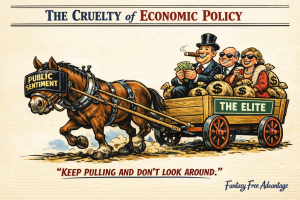 The public has been trained — patiently, thoroughly — to promote its own poverty. Folks say they don’t trust government, but their behavior tells another story. Trust of authority is inborn, and the elite know it. They use government the way a carpenter uses a hammer: not for decoration, but for results.
Politicians love the theories because both give them the same permission slip: Spend. Spend more. And when that doesn’t work, spend again. The more they spend, the better they feel — at least until the bill comes due, and it always comes due.
So does this system constitute cruelty? Well, that’s for the reader to decide. But when a man is fitted with blinders and told he’s free because he can still see straight ahead, that’s not kindness. That’s management.
And it’s the kind of management that keeps the wagon rolling — even if it rolls right over the people pulling it.