Why Big Tech May Fall Before the Debt ever Does
By James Quillian – Economist, Political Analyst, Teacher of Natural Law
Let me start with the simple truth: artificial intelligence will not save the United States from its debt problem. That idea sounds good in a boardroom, but it collapses the moment it touches reality.
 This is not coming from someone who dislikes AI. I use it every day. For four dollars a month, I have a research assistant who never sleeps and can pull up more information in two seconds than a whole staff could gather in a week. AI is a tremendous personal asset. But that does not mean it is a national solution.
The Second Rat Gets the Cheese
We are living through a classic “second rat gets the cheese” moment. The first rat charges into the trap, eager and confident, and dies. The second rat wanders in later and eats well.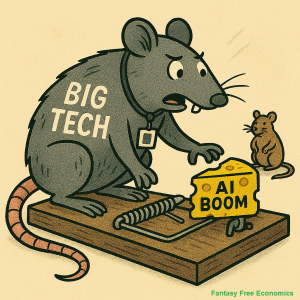
Right now, Big Tech is the first rat. They are pouring billions into AI, convinced it will save their business models, their stock prices, and maybe even the country. They believe AI will create a productivity boom big enough to outrun the national debt.
But the American consumer is not playing along. The public is getting poorer in real terms. They are not attached to AI emotionally or financially. They are not impressed by another subscription, another app, or another “platform” that solves problems they do not have.
There is a better chance that AI will destroy Big Tech than that it will rescue the federal balance sheet. When the trap snaps shut, the second rats will come along, build leaner businesses around AI, and make a profit. They will get the cheese. The current owners will not.
We Replaced the Free Market With a Political Market
In a real free market, price is the main tool for allocating resources. Consumers speak through what they buy. Producers listen or they go broke. That is how a healthy system learns.
We have dismantled that system. In its place, we built a hybrid arrangement where political power quietly replaced price. The biggest corporations prefer it that way. It is easier to manage politicians than to satisfy millions of customers.
AI fits neatly into this world. It is a powerful tool for those who already have power. It helps them centralize, monitor, and cut labor costs. But that is not the same thing as creating broad prosperity. It is not the same thing as paying down a mountain of federal debt.
The Hard Reality of Wages and Competence
Here is the part no one likes to say out loud: Americans, on average, are severely dumbed down and overpaid by global standards. That is not an insult. It is a fact of the global labor market.
Natural economic forces are already at work. Wages in the United States will drift down. Wages in foreign nations will drift up. AI may accelerate this, but it did not cause it. Reality caused it.
Consumers will not suddenly “come around” and rescue Big Tech by buying whatever AI products they are selling. Consumers are still bound by the same old forces: budgets, needs, and common sense.
Why AI Won’t Pay the National Tab
Debt is not just a number. It is a record of promises made without the means to keep them. To deal with that honestly, you need lower spending, higher real production, and political honesty. AI can help with the paperwork, but it cannot supply the honesty.
As long as political power—not price—allocates resources, any productivity gains from AI will be captured at the top and used to prop up the same unsustainable promises. That may delay the reckoning, but it will not prevent it.
The Race to Escape Reality
The race to escape reality begins at birth. We are trained to believe that there is always a workaround, a bailout, or a new technology that will save us from the consequences of bad decisions. AI is just the latest costume for that old fantasy.
But reality is patient. It does not shout. It simply follows us. In the end, reality always wins. Debts that cannot be paid will not be paid. Systems that refuse to listen to real people will fail. Tools that do not serve the user will be abandoned.
AI is powerful. Used wisely, it can be a great personal asset. But it is not a magic wand for the federal government, and it is not a substitute for a real free market. It will not get the United States out of debt. And Big Tech may fall long before the debt ever does.