Why Big Tech May Fall Before the Debt Ever Does

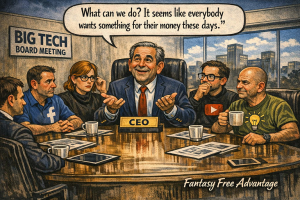
Why Big Tech May Fall Before the Debt ever Does
By James Quillian – Economist, Political Analyst, Teacher of Natural Law

Let me start with the simple truth: artificial intelligence will not save the United States from its debt problem. That idea sounds good in a boardroom, but it collapses the moment it touches reality.

This is not coming from someone who dislikes AI. I use it every day. For four dollars a month, I have a research assistant who never sleeps and can pull up more information in two seconds than a whole staff could gather in a week. AI is a tremendous personal asset. But that does not mean it is a national solution.

The trouble isn’t AI itself. The trouble is the system it has been dropped into.

Continue reading

Predictability, Natural Law, and the Imaginary Economy

Predictability, Natural Law, and the Imaginary Economy
By James Quillian – Economist, Political Analyst, Teacher of Natural Law

Every so often, a reader offers a thoughtful comment that still manages to miss the point. Not because the person is unintelligent, but because they are reasoning inside an imaginary system — a system built on labels, theories, and institutional storytelling. That is exactly what happened here.

THE READER’S COMMENT

READER:
Thanks for breaking that down — it’s a refreshingly blunt way of putting it. I agree that a lot of modern economic theory and forecasting can feel overcomplicated, especially when the core dynamics — debt, taxation limits, and inflation — are actually pretty straightforward.

That said, while the logic is simple, the outcomes aren’t always predictable. Global markets, supply shocks, and public reactions can throw a wrench in even the clearest plan. But your point about the incentives and behavioral factors is spot on — it’s a big part of why inflation persists even when it’s painful for ordinary people.

This is a polite, well‑intentioned response. But it rests on a common assumption: that outcomes are unpredictable because the modern economy is too complex. That assumption is the very thing that keeps people confused.

Continue reading

Who Really Pays? Tariffs, Titles, and the Illusion of Authority


Who Really Pays? Tariffs, Titles, and the Illusion of Authority

Every now and then, a simple question exposes a much bigger problem. Not a math problem, not a policy problem, but a reality problem. Someone recently asked me:

QUESTION:
Do you know Americans paid 90% of the tariffs, not retailers?

That question is not really about tariffs. It is about how we think. Do we define people and institutions by their titles, or by what they actually do? Do we trust labels, or do we watch behavior?

Continue reading

Starting With What We Don’t Know

Starting With What We Don’t Know

By James Quillian – Economist, Political Analyst, Teacher of Natural Law

I teach natural law from a simple place: we start by admitting what we don’t know.
Not as a slogan, not as a trick, but as something we really internalize. We live with it. We let it sit in our bones.

A lot of people speak with great authority. They sound sure. They hold court.
They tell you what life is, what death is, what the universe is doing and why.
Many of them know, deep down, that they don’t actually know. But they talk like they do anyway.

Knowing that we don’t know is a kind of prophylactic. It protects us from being compromised by those who pretend to have all the answers. Once you accept that some things are truly unknown, you stop being easy to herd.

Continue reading

The Illusion of Demand: Why Economic Forecasts Hide the Coming Entertainment Collapse

 Why Economic Forecasts Hide the Coming Entertainment Collapse

By James Quillian | Economist, Political Analyst & Teacher of Natural Law

The Blindness of Quantitative Analysis

Mainstream economists and government agencies are currently projecting a “Golden Era” for entertainment, claiming the U.S. market will exceed $800 billion by 2028. However, looking at these numbers is like looking at a mirage. Quantitative analysis—the practice of measuring the world solely through spreadsheets—is right only about 25% of the time. Why? Because it ignores the Natural Law of cause and effect.

Forecasts are inherently biased toward the status quo. They assume that because a corporation is large, it is stable. But in the natural world, when a body grows too large for its environment to support, it begins to consume itself. We are seeing this now as the “entertainment giants” use dishonest accounting and predatory consolidation to mask a hollow core.

Continue reading

The Inevitable Headwinds Facing American Incomes and Lifestyles

The Inevitable Headwinds Facing American Incomes and Lifestyles

James Quillian, Economist, Political Analyst, Natural Law

American folks are up against some tough times when it comes to their paychecks and way of living. No matter where you stand right now, incomes are set to drop hard—except maybe for those in the trades. Here’s the straight talk on why that’s coming.

A Degree Isn’t the Same as Being Educated

Just having a college paper in your hand doesn’t make you truly educated. We’ve fallen behind the rest of the world in real learning and skills. Other places are catching up fast, and we’re not keeping pace. This gap is going to hit our wallets hard.

Continue reading

Dignity, Good Trades, Own Your Tools

A short manifesto for living deliberately

James Quillian, Economist, Political Analyst, Natural Law

I’ll wave the red flag up front: this isn’t another feel‑good listicle. It’s a plainspoken prescription I learned from watching people who win at life the hard way. Have dignity.

Make good trades. Own your own tools. Say it out loud. Live it.Dignity

Dignity isn’t a trophy you wear. It’s a line you draw in the dirt and refuse to cross. When I say dignity, I mean knowing how low you’re willing to go and making that boundary non‑negotiable. That boundary keeps you honest, keeps you steady, and makes your decisions simple when the wind blows hard.

Walk into a room and you’ll see two kinds of people: the ones who bend to the loudest voice, and the ones who stand straight because they already decided what matters. Dignity is the muscle that lets you stand straight

Continue reading

The Monster in the Machine: Our Last Chance to Reclaim AI

Monster in the Machine:

James Quillian, Economist, Political Analyst, Natural Law

We are standing at a precipice. This is our last chance.

The internet was once a digital frontier, a great equalizer that promised to democratize information and voice for everyone. It was a space where a single individual could stand on equal footing with a titan. That dream died the moment corporations took control of the infrastructure. They fenced the commons, monetized our attention, and turned a tool of liberation into a machine for surveillance and profit.
Continue reading

AI and the New Garden of Eden

Why a World Without Stress Is a World Without Progress

James Quillian, Economist, Political Analyst, Natural Law

Free markets reduce inequality. AI promises to remove effort. One of these statements is about to ddestroy the other.

The only proven engine for reducing inequalities across history has been free markets. Yet today we stand at the threshold of a technology that could make the very effort required for markets—and for human flourishing—obsolete: artificial intelligence.

Continue reading

The Recovery of Natural Sensibility: Beyond the Lies of Life

We are taught to look at the world through a veil of “learned sensibilities”—civilized filters that tell us what to think, how to feel, and what to ignore. But beneath this thin veneer of training lies a reality that every soul recognizes, yet few dare to name
The Two Pillars of Reality
To return to reality, one must first acknowledge the two fundamental laws that govern our existence from the moment of our first breath.:


The Eternal Power Struggle: Every baby is born into an ongoing, eternal conflict. It is the backdrop of all life. There is no neutral ground; there is only the movement of power.

Continue reading

The Breadline vs. The Waiting LisWas the Great Depression Better Than the Soviet “Golden Age”?

If you haBook Cover Full Size.pngd to choose between living through the worst year of the Great Depression in America or the best year of the Soviet Union, which would you pick?

At first glance, it seems like a no-brainer. The Great Depression (the 1930s) was a time of 25% unemployment, “Hoovervilles,” and dust storms. But when we look at the actual living standards, the comparison is surprising. Even at our lowest point, American life had “bones” that the Soviet Union struggled to build even at its peak in the 1970s.

  1. The “Stuff” Gap: Cars, Toasters, and Radios

During the Great Depression, the problem wasn’t that America didn’t have “stuff”—it was that people couldn’t afford to buy it. The factories, the paved roads, and the electrical grids were already there.

By contrast, even during the Soviet Union’s “best” years in the 1970s, many modern comforts were still luxury items.

  • The Car Test: In 1930s America, even with the economy crashing, there were millions of cars on the road. In the 1970s USSR, you might have to wait ten years on a list just to buy a basic vehicle.
  • The Kitchen: In the depths of the Depression, many Americans still had indoor plumbing and electricity. In the peak Soviet years, “communal apartments”—where multiple families shared one kitchen and one bathroom—were still the reality for millions.
  1. Food: Quality vs. Quantity

In 1932 America, people were hungry because they were broke, leading to the famous “breadlines.” In the Soviet Union, people were often hungry because the system couldn’t get food to the stores. Continue reading

Curbside Jimmy’s Prophetic Song Interpreted

“When Times Got Really Weird” is a folk-style narrative song that serves as an allegory for societal collapse, the loss of self-reliance, and the dangerous allure of authoritarianism in times of crisis.

The lyrics depict a progression from economic hardship to spiritual desperation, and finally to a total loss of freedom. Below is an interpretation of the song’s key themes and symbols:

Continue reading

AI Search Honesty and Integrity

AI Search Honesty and Integrity
James Quillian, Economist, Political Analyst, Natural Law

Posted on December 20, 2025 by jamesq

How honest are AI search engines? Here is what I am initially finding. One is honest. The other is quite deviously more interested in trying to lower my interest in the question.

 Is it okay for world leaders to have been present on the Epstein Island where underage girls were the main attraction, being raped and exploited and treated as totally innocent under the law?

 I asked the question above on two completely different AI search engines, Meta and Ask AI.  Each answer yielded completely different answers. Meta gave a soft pedal type of answer, giving the benefit of any doubt, to any luminary who might be implicated in the files. Also, META changed the subject by shedding doubt that there was evidence of any world leader being on the island. I accused no one in particular. On the other hand Ask AI gave a great thoughtful answer and answered only the question I asked.

The situation involving Epstein Island – also known as Little St. James…. is a serious and disturbing case of alleged human trafficking and  exploitation. Multiple allegations have been made against Jeffrey Epstein and some of his associates regarding the exploitation of
underage girls on the island. Regarding world leaders, some have been associated with Epstein, but there’s limited publicly available
information confirming their presence on the island. Any potential involvement or knowledge of the activities on Epstein’s island would require a thorough investigation. Multiple investigations and lawsuits  have been conducted, and some individuals have been convicted of crimes related to Epstein’s activities. However, specific information about world leaders’ involvement or presence on the island is not widely available or confirmed. Would you like more information on the Epstein case or related investigations?

Ask AI The question of whether it is acceptable to have been present on Jeffrey Epstein’s island, given the documented crimes of sexual abuse and exploitation of underage girls, is unequivocally no. Presence on the island, particularly for individuals who were aware or should have been aware of the illicit activities, implies complicity or at the very least, a severe dereliction of moral and ethical responsibility. The ongoing nature of human trafficking and child sexual exploitation makes the involvement of prominent figures in such activities particularly egregious, as it directly undermines efforts to combat these crimes].
According to www.iAsk.Ai – Ask AI:

The legal and ethical ramifications of being associated with Epstein’s activities are profound. Legally, individuals present on the island could face scrutiny for potential involvement in or facilitation of the crimes, obstruction of justice, or other related offenses, depending on their level of knowledge and participation [3]. Ethically, any association with such egregious acts of child abuse is morally reprehensible. For world leaders, who are expected to uphold justice, protect vulnerable populations, and set an example of ethical conduct, involvement or even mere presence in such a context represents a catastrophic failure of their duties and a betrayal of public trust [4]. Their role should be to actively combat human trafficking and pedophilia, not to be implicated in it. The continued prevalence of human trafficking and child sexual exploitation underscores the critical need for leaders to be beyond reproach in these matters.


Shrinking Merchandise Trade Deficit Significance

Shrinking Merchandise Trade Deficit Significance
James Quillian, Economist, Political Analyst, Natural Law

That concerns me greatly. A large trade deficit means that there is prosperity in our population. We have surplus money to spend and a lot of it is buying goods from other countries like China. What do the Chinese do with their profits? They either spend it on what our service economy offers or they invest in our capital markets. That balances our capital account and everything is even.

Here is the problem. Much of our service sector has been bolstered politically. At the same time services the Chinese have always been interested in are waning in utility for them. They are buying less of our services or plan on buying less.

Due to our four decades of employing our unacknowledged, unofficial, asset enhancement initiative, our financial assets are astronomically overpriced.

All of this means that the global prosperity bubble has bottle – necked. The worldwide prosperity balloon bubble is starting to deflate. This presents a problem. Demand for goods and services collectively or globally is diminishing. The result is – a major depression (not a  recession) is in its incipient stage. Sadly, a recovery can only be launched via free market influences. Worldwide, free market influences have largely been legislated out of existence.

Today’s prosperity has been created politically. The prosperity is concentrated within the few with the massive political power to get self-serving legislation passed. Following the middle ages, it was discovered that individuals acting independently accomplish greater things than is the case where life’s activities are managed by a central authority.

Groupthink never works out well. Central planning is indeed groupthink on steroids. Benefits from central planning for a few , can be profound in the short run. In the long term, central planning outcomes are disastrous. The short run is over now. Governments can’t make economic decisions. They can only make political decisions. Political decisions are always based on groupthink.

AI Summary of Article

In essence, the provided text from jamesquillian.com argues that a shrinking merchantmen trade deficit, while seemingly a positive indicator, is a symptom of deeper economic issues. The author suggests that politically driven economic policies, overvalued financial assets, and diminishing foreign demand for services are leading to a global economic downturn, potentially a major depression, exacerbated by the suppression of free market influences and the failures of central planning.